

Hiring employees in Bangladesh requires foreign companies to understand the country’s employment regulations, statutory obligations, and local HR practices. From determining the applicable employment framework to structuring compensation and managing employee separation, employers need to consider several local requirements to establish a compliant workforce.
For international businesses, understanding how Bangladesh’s employment regulations interact with their existing global HR policies is particularly important. Employment practices that work in another jurisdiction may require adjustments to reflect local statutory requirements and employment practices. A management consulting firm in Bangladesh helps foreign investors and growing businesses design their hiring strategy, HR processes, workforce structure, and operational framework before compliance issues become business risks.
This guide explores the key employment and HR compliance considerations foreign companies should understand when hiring employees in Bangladesh, from employment documentation and working conditions to employee benefits, work permits and termination procedures.

Key Considerations Before Hiring Employees in Bangladesh:
Before commencing recruitment, foreign companies should understand the regulatory and operational requirements associated with employing people in Bangladesh. The following areas are particularly important when establishing a local workforce.
1. Determine the Appropriate Business Presence in Bangladesh
Foreign companies planning to employ people in Bangladesh should first understand the appropriate legal and operational structure for conducting business in the country. Depending on their investment objectives and proposed activities, they may establish a locally incorporated company, a wholly foreign-owned subsidiary, a joint venture, a branch office or a liaison/representative office, subject to the applicable regulatory approvals and conditions.
These arrangements do not carry identical operating permissions. For example, a liaison or representative office generally has restricted activities and cannot be treated as an ordinary commercial operating entity. Similarly, a branch office operates within the scope of its approved activities.
The chosen structure has implications for employment arrangements, payroll administration, taxation, regulatory compliance and the engagement of foreign nationals. Understanding these requirements at the outset helps companies determine the appropriate arrangements for employing local and foreign personnel.
2. Ensure Employment Contracts and Appointment Letters Comply with Local Requirements:
International companies often maintain standardized HR policies and employment documentation across their global operations. However, these documents may require localization to reflect Bangladesh’s statutory employment requirements and local employment practices.
Employers should consider the applicable requirements when preparing appointment letters, employment contracts and related documentation. This includes the relevant employment classification, statutory employment conditions, probation arrangements and separation requirements.
A locally compliant employment documentation framework helps establish clear employment relationships while allowing companies to maintain consistency with their broader global HR policies.
3. Establish Local HR and Payroll Management Processes:
Foreign companies should establish appropriate HR and payroll processes to manage their Bangladesh-based employees in line with local requirements. These processes generally cover employee on-boarding, payroll administration, attendance, leave management, statutory deductions, employee records and other applicable employment obligations.
A structured approach to HR consulting will help companies in Bangladesh build systems that can scale rather than managing every employee issue manually. Where a company already operates a global HR framework, the local processes can be aligned with that framework while incorporating Bangladesh-specific requirements. This helps maintain consistency in HR administration without overlooking local compliance responsibilities.
4. Understand the Bangladesh Employment Regulatory Framework:
Employment relationships in Bangladesh are governed by a range of laws and regulations, with the Bangladesh Labour Act, 2006 and the Bangladesh Labour Rules, 2015 forming a central part of the employment regulatory framework. These laws, together with their subsequent amendments, address various aspects of employment, including working conditions, wages, working hours, leave, employee benefits, workplace safety and employment separation.
Foreign companies should understand the applicability of these provisions to their establishments and employees before developing their local employment policies and practices. It is also important to distinguish between employees covered by the Labour Act and individuals whose employment may be governed by other applicable legal provisions or contractual arrangements.
Although companies may maintain global HR policies and offer benefits beyond statutory requirements, their local employment practices should remain consistent with the mandatory provisions of applicable Bangladesh laws.
Bangladesh Labour Law Basics Every Foreign Employer Should Know:
Appointment Letter and Employee Documentation:
Employers operating in Bangladesh should understand the statutory requirements for issuing appointment letters and maintaining employee records under applicable labour regulations. Employment documentation should reflect the nature of the employment relationship, the applicable employment classification and the relevant statutory requirements.
Proper documentation helps establish clear employment terms, maintain regulatory compliance and manage employment-related matters throughout the employee lifecycle.
Working Hours, Overtime and Leave Requirements:
Foreign employers should understand the statutory provisions governing working hours, weekly holidays and overtime in Bangladesh. The applicable regulations prescribe ordinary working-hour limits, conditions for overtime work and the rates at which eligible employees are compensated for overtime. These requirements should be appropriately reflected in local working-hour policies and payroll practices.
Bangladesh labour regulations also provide for different categories of employee leave, including casual leave, sick leave, annual leave and festival holidays, subject to the applicable statutory provisions and eligibility conditions. Employers should understand the entitlement, calculation methodology and applicable conditions for each category when developing their leave policies.
Accurate attendance, overtime and leave records are important for ensuring that employees receive their applicable entitlements and that employers can demonstrate compliance with relevant employment requirements.
5. Plan for Long-Term Workforce Management:
BEFORE YOUR FIRST BANGLADESH HIRE
01
BUSINESS STRUCTURE
Choose the right operating model
↓
02
EMPLOYMENT REQUIREMENTS
Understand applicable labour legislation and employee classifications.
↓
03
EMPLOYMENT DOCUMENTATION
Prepare locally compliant appointment letters and employment agreements.
↓
04
HR AND PAYROLL COMPLIANCE
Establish processes for salary administration, working hours, leave and statutory benefits
↓
05
LEGAL COMPLIANCE
Understand labour requirements
↓
06
EMPLOYEE MANAGEMENT
Prepare for ongoing compliance, employee protection and separation requirements.
Understanding these requirements helps foreign companies establish a compliant employment framework from the beginning.
Employee Benefits and Statutory Obligations:
Employee Benefits, Compensation and Statutory Obligations
In addition to wages and salaries, employers in Bangladesh need to consider various statutory employee benefits and financial obligations when structuring compensation and administering payroll. These may include maternity benefits, festival bonuses, provident fund arrangements, gratuity, workers’ profit participation and other employee welfare provisions, depending on the applicability of the relevant laws and statutory conditions.
Foreign companies should understand the circumstances under which these benefits become applicable, the employees covered, and the relevant calculation and payment requirements. They should also distinguish between statutory entitlements and additional benefits voluntarily offered by the employer, such as private medical insurance or enhanced employee benefits.
Compensation structures should be designed with applicable statutory requirements in mind. In particular, employers should understand how salary components are treated for the purposes of relevant benefit calculations, payroll administration and statutory payments.
A clear understanding of these obligations helps foreign companies establish appropriate compensation policies and manage payroll and employee benefits more effectively.
Hiring Foreign Nationals in Bangladesh: Visa and Work Permit Requirements:
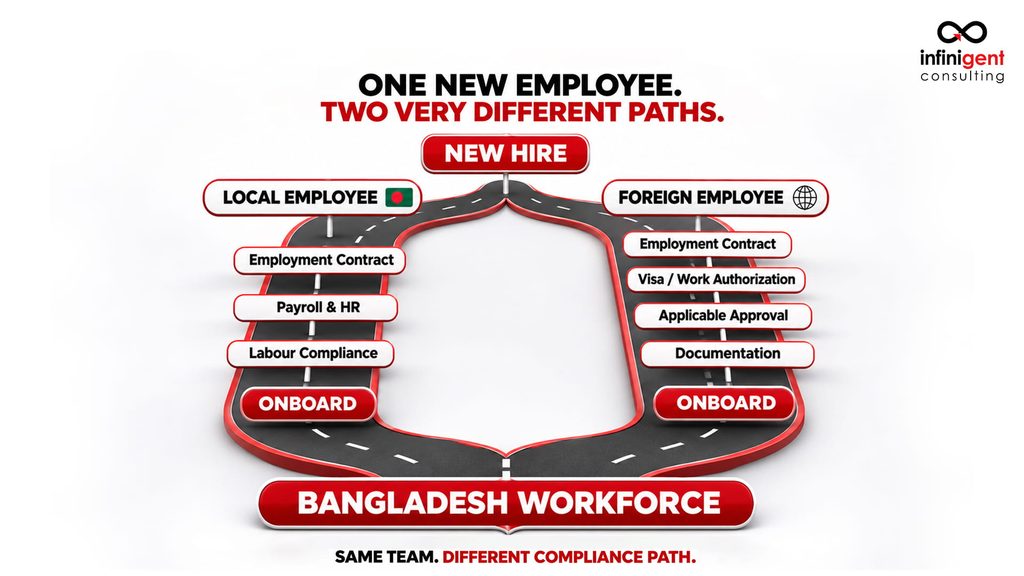
Foreign companies operating in Bangladesh may need to recruit foreign nationals for management, technical or specialized positions. However, employing foreign nationals involves additional immigration and regulatory requirements beyond those applicable to local employees.
Foreign nationals generally require the appropriate visa and work permit approvals to undertake employment in Bangladesh. The relevant authority and application procedures depend on the nature of the employer and the location of its operations.
For eligible private-sector establishments, the Bangladesh Investment Development Authority (BIDA) is an important authority for work permit-related services. Companies operating in Export Processing Zones (EPZs) or other designated zones may need to follow the procedures prescribed by the respective zone authorities.
The process generally involves the following considerations:
1. Employer Eligibility and Registration
The employing organization should have the appropriate registration, approvals and operational status required by the relevant authority.
2. Visa and Work Permit Requirements
Employers should understand the applicable visa category and work permit requirements before arranging employment for a foreign national. The relevant procedures and sequence of approvals should be confirmed with the competent authority.
3. Supporting Documentation
Depending on the application route, supporting documents may include company registration documents, trade licences, tax-related documents, board approvals, employment details and justification for engaging foreign expertise.
4. Security Clearance and Renewal
Employers should monitor work permit validity, applicable security clearance requirements and renewal deadlines. Maintaining updated employee and immigration records is important for continued compliance.
Incomplete documentation or delays in obtaining or renewing the necessary approvals can disrupt employment arrangements and create regulatory complications.

GLOBAL HR POLICY
BANGLADESH EMPLOYMENT COMPLIANCE
Global Approach:
- Company culture
- Leadership style
- HR framework
↓
Local Adaptation:
- Applicable labour legislation
- Local employment documentation
- Statutory compensation and benefits
- Payroll and tax requirements
- Visa and work permit requirements
A consistent global HR philosophy can be supported by employment practices that reflect local laws and regulatory requirements.
Common Employment Compliance Mistakes Foreign Companies Should Avoid:
Foreign employers entering Bangladesh may encounter employment compliance challenges when local regulatory requirements are not adequately considered during the hiring and employee management process. Some common areas requiring attention include:
1. Failing to Localize Global Employment Policies:
Using standardized global HR policies and employment documentation without reviewing their applicability under Bangladesh law can result in inconsistencies between company practices and local statutory requirements.
2. Overlooking Business Structure and Employment Permissions:
Employers should understand whether their business presence and regulatory approvals support the intended employment and operational arrangements. This is particularly important for branch offices and liaison or representative offices with restricted activities.
3. Misunderstanding Employment Classification:
The legal classification of employees can affect the application of different labour law provisions. Employers should consider the relevant legal definitions and requirements rather than automatically applying the same employment terms and statutory treatment to every position.
4. Inadequate Employment and Payroll Documentation:
Incomplete employee records, inaccurate payroll documentation and poorly maintained attendance and leave records can create difficulties during regulatory reviews, employee disputes and employment separation.
5. Overlooking Statutory Employee Benefits and Separation Obligations:
Failure to identify applicable employee benefits, statutory payments and separation requirements can result in incorrect payroll calculations, outstanding liabilities and employment-related disputes.
Termination and Employee Separation Considerations
Ending an employment relationship requires careful planning.
Foreign companies should understand:
- Notice requirements
- Documentation procedures
- Settlement obligations
- Employee records
Termination decisions should follow proper internal processes and applicable legal requirements. Clear HR policies should be in place well before any dispute arises.
How a Management Consulting Firm in Bangladesh Supports Foreign Companies
Hiring is not an isolated HR activity.
It connects with:
- Business structure
- Investment planning
- Operational strategy
- Workforce design
- Compliance systems
- Long-term growth planning
A management consulting firm in Bangladesh helps foreign companies create a structured approach by supporting:
Workforce Planning:
Determining:
- Required roles
- Hiring timeline
- Organizational structure
HR Framework Development:
Creating:
- Policies
- Processes
- Reporting structure
Market Entry Strategy:
Aligning:
- Business objectives
- Local requirements
- Operational readiness
Foreign Investment Advisory in Bangladesh
Helping investors understand how workforce decisions connect with their broader Bangladesh expansion strategy.
FROM GLOBAL TALENT TO BANGLADESH WORKFORCE:
01
Company Setup
↓
02
Employment Planning
↓
03
Documentation
↓
04
Work Permit Process
↓
05
Successful Onboarding
Every step builds operational confidence.
Pre-Hire Checklist for Foreign Companies
Before hiring employees in Bangladesh, review:
✓ Business structure confirmed
✓ Employment contracts reviewed
✓ Salary structure defined
✓ HR policies prepared
✓ Payroll system ready
✓ Labour compliance reviewed
✓ Foreign employee permits planned
✓ Employee documentation process established
Choosing the Right Partner for Bangladesh Expansion
Hiring employees in a new country involves more than recruitment.
It requires understanding local regulations, workforce planning, business structure, and operational requirements.
The right advisory partner helps foreign companies move from uncertainty to a structured expansion plan.
When selecting a management consulting firm in Bangladesh, evaluate:
- Local market knowledge
- HR and operational experience
- Regulatory understanding
- Strategic planning capability
- Implementation support
A successful Bangladesh expansion starts with the right foundation.
Explore Infinigent’s Management Consulting Services
This article provides general information and should not be considered legal advice. Companies should consult qualified legal professionals for specific employment matters.
Frequently Asked Questions
Q1) Can foreign companies hire employees in Bangladesh?
Yes. Foreign companies can hire employees in Bangladesh after establishing the appropriate business structure and following applicable employment regulations.
Q2) What should an employment contract in Bangladesh include?
Yes. Employment contracts generally include employee details, job responsibilities, salary information, working conditions, leave provisions, and other employment terms.
Q3) Do foreign employees need a work permit in Bangladesh?
Yes. Foreign nationals generally require appropriate approvals and work permits before working legally in Bangladesh. Requirements depend on the employer structure and applicable authority processes.
Q4) Why should foreign companies use HR consulting services in Bangladesh?
Yes. HR consulting helps companies build compliant hiring systems, workforce structures, employee policies, and operational processes suitable for the Bangladesh market.