

Some foreign investors enter Bangladesh without a local advisor and succeed, while others encounter unexpected delays in regulatory filings, entity structuring, or workforce planning. Engaging local expertise early can help businesses anticipate requirements and make informed decisions before committing resources.
This article looks at what a management consulting firm in Bangladesh does, where in-house teams benefit most from local support, and how to decide whether your business needs one.
1. What a Management Consulting Firm Does in Bangladesh
A consulting engagement in Bangladesh goes beyond a general strategy document. It typically covers four areas: market and competitor analysis specific to your sector, entity structure and regulatory sequencing (BIDA, RJSC, NBR), operational setup including hiring and vendor sourcing, and ongoing advisory as the business scales. A well-structured engagement scopes these areas separately, because the amount of work and risk in each varies by business type.
It helps to ask the firm to explain which of these four areas your engagement covers, and why. Advisory is most valuable when it is tied to the specific decisions it will inform-hiring, pricing, vendor selection, regulatory filings-rather than described in general terms.
2. Where In-House Teams Benefit From Local Support
Foreign companies entering Bangladesh without local advisory support may encounter challenges in several areas, including:
- Sequencing challenges. BIDA registration, RJSC incorporation, and bank account opening generally follow a required order, and that order varies by structure. Starting in the wrong sequence for example, attempting to open a bank account before the required approval is issued can cost valuable time in re-doing steps.
- Entity mismatch. A company that selects a liaison office primarily for ease of setup may later discover that this structure does not support its intended revenue-generating activities. In such cases, it may need to explore an alternative structure, such as a branch office or subsidiary, subject to applicable requirements.
- Hiring exposure. Appointment letters based on a head-office template may not reflect Bangladesh-specific requirements-such as probation rules, statutory leave, and provident fund provisions which can create compliance risk from the first hire.
Individually, these challenges are manageable. Together, they can extend a market entry timeline significantly, which is why early planning matters.
3. Why Early Local Advice Helps Reduce Cost and Delay?
Without local advisory support, businesses may face delays or make decisions without sufficient market-specific information. For example, pricing strategies may lack local competitor data, hiring plans may overlook staffing or work-permit requirements, and vendor contracts may not account for local payment practices. Addressing these considerations early can help reduce avoidable costs and delays.

4. When a Consulting Firm Is Worth Engaging
Not every business needs the same level of support. A consulting firm adds clear value when:
- You’re entering Bangladesh for the first time and don’t have an existing local legal & tax advisor
- Your entity structure decision affects liability, tax treatment, or how fast you can start trading
- You’re scaling an existing local operation and need a restructuring or process review
- Your head office needs a credible, independent assessment before approving further investment
It adds less value if you already have an established local team with direct regulatory experience, or if your engagement is limited to a single, well-defined legal filing—in that case, a specialist lawyer or accountant may be a better fit than a full consulting engagement.
5. What to Expect From a Well-Defined Engagement
A well-structured engagement follows a defined process with clear phases:
- Discovery and assessment phase: review of your business model, target sector, and entry objective
- Structure and regulatory plan: Recommend an appropriate entity structure, outline BIDA/RJSC sequencing, and prepare a documentation checklist.
- Operational setup support: Support hiring plans, vendor sourcing, banking arrangements, and compliance scheduling
- Post-entry advisory: Establish a check-in schedule and define the engagement’s end point.
It helps to ask for this structure explicitly. A clear phase-by-phase description helps clients understand the engagement’s scope, expected deliverables, and intended outcomes. When ongoing support is proposed, these details should also be defined clearly.
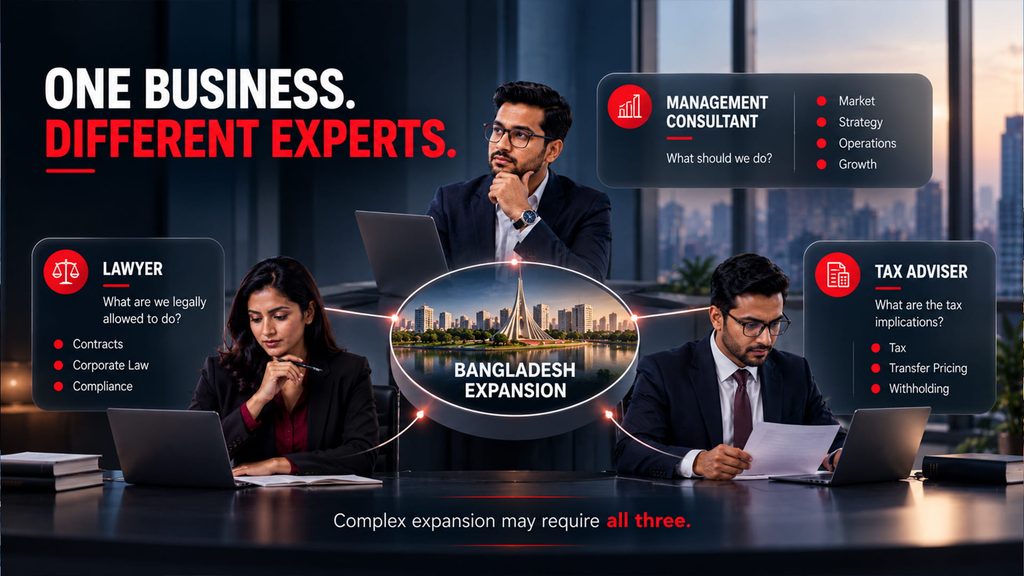
6. Sector Context Changes What “Local Expertise” Means
The local expertise required varies by sector, as each industry has distinct operational and regulatory considerations.
A manufacturer evaluating Bangladesh needs data on bonded warehouse eligibility, utility connection timelines, and labour availability in specific industrial zones. A technology or IT-enabled services company needs to understand the tax holiday structure for IT/ITES firms and talent availability in Dhaka versus secondary cities. A trading or distribution business needs import/export licensing requirements and NBR’s HS code classifications for its product categories.
Sector-specific work shows up as data and recommendations tied to your industry, rather than a country-level summary that could apply to any investor. It is worth asking for that level of detail up front.

How Infinigent Approaches Foreign Investor Engagements
Infinigent works with foreign investors and growing Bangladeshi businesses across the four areas above: market analysis, entity and regulatory strategy, operational setup, and ongoing advisory. Engagements are scoped around the complexity of your entry, not a fixed package, because, for example, a retailer entering through a subsidiary and a manufacturer scaling an existing branch need different work.
Questions to ask before engaging any consulting firm
- Which of the four core areas market analysis, entity structure, operations, advisory does this engagement cover?
- What’s your direct experience with BIDA, RJSC, and NBR processes for a business like mine?
- What does the discovery phase look like before you propose a plan?
- Who on your team will be assigned to this engagement?